By ANNETTE TAPERT
 |
Time Life Pictures/Getty Images
|
BEAUTIFUL
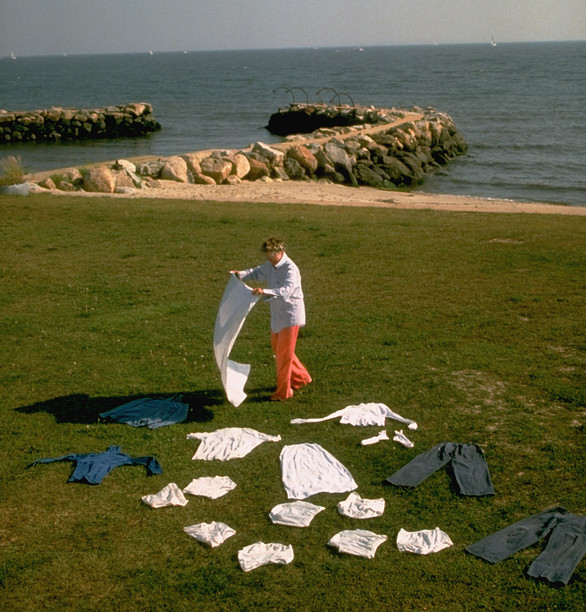
LAUNDRETTE | Katharine Hepburn air drying clothes on her lawn in Connecticut,
1995.
I have
many fashion fixations. High on my list is clothing maintenance. Sloppy
pressing, iron marks, stains—all can send me into a fit of "Mommie
Dearest" rage. My idea of fun is cruising websites dedicated to garment
care. Why the interest? Because when I've shelled out a lot of money for
clothes, I think there's a responsibility to protect the investment. Would you
buy a luxury car and not care for it properly? I think not. Same goes for
designer threads. At least with a car the dealership services it for you.
Department stores and
boutiques don't offer a maintenance program (which I've always thought would be
a great idea), though some shops will suggest a good dry cleaner if your
garment is the victim of a hideous stain.
Dry cleaning vs. washing
For as long as I can remember, I was told never to dry
clean unless absolutely necessary because it destroys fabrics, causes shrinkage
and can make the clothes lose their shape. That's a myth—if you have a great
cleaner, said George Torpe, whose dry-cleaning operation is tucked inside the
basement of an apartment building on Manhattan's Upper East Side. (George Torpe
Inc. is where I send pieces that need special attention.) "This was advice
offered long ago by the old-time European tailors," said Mr. Torpe, whose
family-run business was started by his father after World War II. "But
techniques have changed, the solvents are better. We don't use perc."
That's short for perchloroethylene, the standard industry dry-cleaning fluid.
My man Torpe performs his magic with hydrocarbon solutions. "Don't let
anyone who doesn't know what they're doing take care of your clothes," he
said. "There's a specific cleaning process for every type of
garment." If your clothes come back from the dry cleaner smelling of
fluid, he said, it's because the cleaner is short cycling the process.
"The solvent hasn't gone through enough cycles. A lot of cheaper, mass
production firms do that." The biggest offenders, according to Mr. Torpe,
are establishments that offer same-day service.
“When I've shelled out a lot of money for clothes I think
there's a responsibility to protect the investment. Would you buy a luxury car
and not care for it properly?”
Inferior dry cleaning inspired Lindsey Boyd and Gwen
Whiting to create the Laundress, a line of eco-friendly fabric-care products
launched in 2004. Both founders hold degrees from Cornell University in fiber
science, textile and apparel management and design. After working in retail
(Ms. Boyd for Chanel, Ms. Whiting for Ralph Lauren) they teamed up to develop
solutions to simplify and master the fine art of laundering. "Almost
everything is hand or machine washable," Ms. Boyd said. "But you need
the right products." The pair spent two years testing clothes with
"dry clean only" labels. That was music to my ears, as I've always
been skeptical about the process, particularly on white cotton shirts with a
touch of stretch. "The label is there because it takes the onus off the
retailer," said Ms. Boyd. Their first product, Wool & Cashmere
Shampoo, is still the Laundress's best seller, followed by Delicate Wash for
silks, cottons and synthetics. Their website offers how-to videos on everything
from getting rid of perspiration stains to machine washing a Chanel
wool-blended jacket. I couldn't resist testing out the latter, but too scared
to use one of my own wool pieces, I bought a jacket at a thrift store. It
worked. Even my husband, a meticulous dresser, was impressed with the results.
I told Mr. Torpe about the experiment. He didn't dispute that it was possible,
but posed a good question: "Did I really want to spend the time?"
Well, not really. Still, I like knowing that it can be done.
Out, damned spots
Over the years, Mr. Torpe has given me myriad tips. The
most important being how to treat a stain—oil, coffee and spaghetti sauce, to
name a few. When it happens, do nothing. That's hard for most of us. Ever been
to a party and spilled red wine on yourself? Invariably, a few helpful Heloises
will weigh in with the standard remedies. Rub salt on it! No, soda water. Or
the ridiculous, "white wine always works" line. "The less you
do, the easier it is for the cleaner to get the stain out," Mr. Torpe
said. "The real problem occurs when people start dabbing at it. If it's a
clump of something just dab off the excess with a white napkin or paper towel,
but that's all."
The Laundress ladies also suggest leaving a
stain alone. Instead of racing
to the dry cleaner, they suggest using their Stain Solution for stubborn spots.
It's meant to be applied to the garment, which is then soaked and laundered. I
tested it on a white silk shirt that had seen better days. I purposely stained
it with red wine on one sleeve, coffee on another, and smeared some mustard on
the front of the blouse for good measure. All of the stains came out and the
shirt washed beautifully with Delicate Wash. I compared the Laundress stain
product with a few familiar brand-name spot removers. Some of those worked
equally well, but what I like about the Laundress is that it's odorless and
nontoxic, and the instructions on the bottle are precise.
Store your winter wardrobe
Now that its spring and you're ready to stow your
cold-weather clothes, here's some expert advice. Clean your clothes before
storing them for the season. Perfume and deodorant stay in fabrics, are hard on
the fibers and attract moths. There are also those invisible food stains. You
may not see them, but a moth will smell one and have a picnic. These ghost
spots also have a tendency to oxidize and turn yellow. The Laundress ladies
advise storing your winter clothes in cotton bags. "Plastic containers and
cardboard boxes attract bugs," said Ms. Boyd. The Laundress also offers a
washing service if you're interested in a dry-cleaner-less experience. Critters
aside, storing clothes in plastic is a bad idea. "It destroys
fabric," Mr. Torpe said. "Natural fibers need oxygen. And white
clothes will yellow over time if left in plastic."
Battling wrinkles (in clothes)
Cottons, lightweight silks and blends crease like mad.
For these fabrics, Ms. Boyd said your best friends at home are a good iron and
a steamer (by the way, both are more than just fair-weather pals). But then
there's linen. I had abandoned it entirely—the wrinkling upset me too much.
Every winter I visit friends in the Caribbean, where my host wears the crispest
linen shirts, shorts and trousers I've ever seen. For years I wondered how he
could wear a linen outfit and contract nary a wrinkle. I conceded that perhaps
there are people who wrinkle and people who don't—a notion promoted by a late
friend of mine who attributed her absence of wrinkles to the way she moved her
body. During my stay this year I wandered into the host's laundry room and
grilled the housekeeper. After all the research I'd done on linen I had yet to
hear of this technique: machine wash in cold water on gentle cycle, then put in
dryer, on warm temperature. Don't iron damp, as every care expert instructs,
but do so when the garment is bone dry, and press on both sides of the fabric
using spray starch until the starch has completely dried.
This morning, I tested the technique on a linen shirt
before sitting down at my desk to write. Here I am, two hours later, and except
for a slight crease in the elbows, the only wrinkles I have are the ones on my
face.
Self-Service
The tools you need to blot out stains on white shirts,
launder your delicates delicately, smooth wrinkles on linen and safely store
cashmeres and coats.
Laundress
products
Instead of dry cleaning
a wool jacket, try using the Laundress's Wool and Cashmere Shampoo ($19).
For silk and cotton stains, apply their Stain Solution ($18)
and then launder with the Delicate Wash ($19). thelaundress.com
A
cotton bag lets your clothes breathe
For seasonal storage, cotton bags let your
clothes breathe, combat yellowing and won't attract bugs like plastic can.
Natural Cotton Jacket Bag, $18, containerstore.com
Mesh
bag
When machine washing items, use mesh bags to protect
garments. Large Zip Wash Bag, $5, bagstand.com
A version of this article appeared
Mar. 17, 2012, on page D3 in some U.S. editions of The Wall Street Journal,
with the headline: Coming Clean Self-Service.
Copyright 2012 Dow Jones
& Company, Inc. All Rights Reserved
Photographs F. Martin Ramin for The Wall Street Journal, Styling by
Anne Cardenas